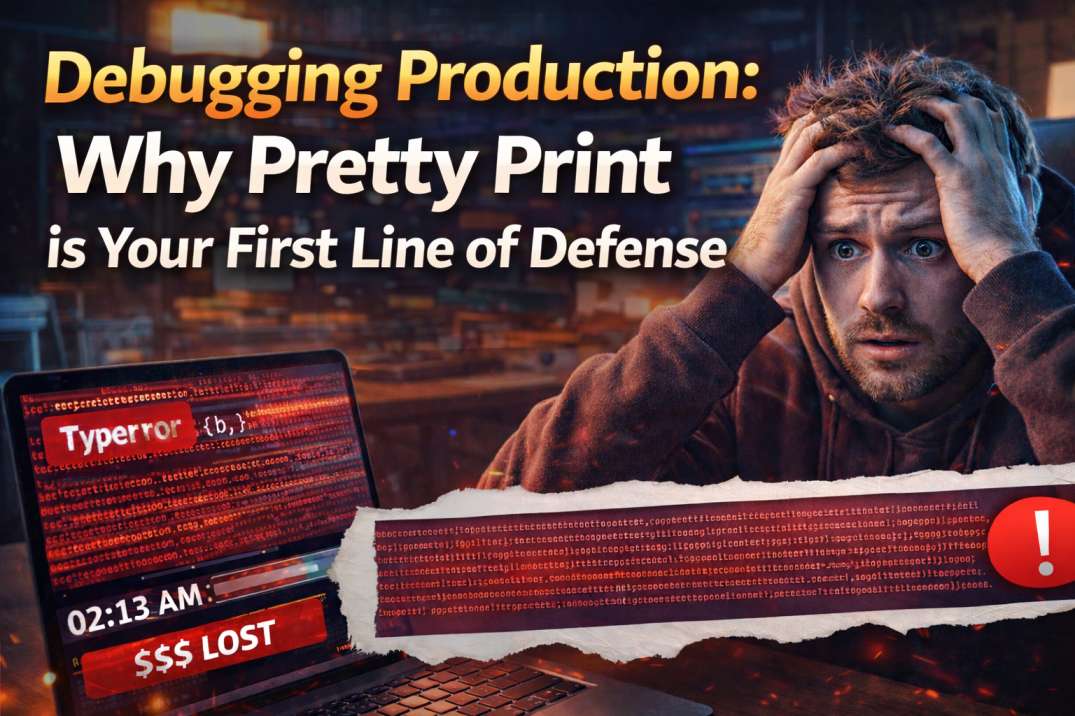
It's 2 AM. Your production system is down. The error log shows a single line of minified JavaScript that spans 847,293 characters. Somewhere in that compressed chaos is the bug that's costing your company thousands of dollars per minute. Welcome to modern debugging.
About the Author
Written by the vidooplayer Team with 10+ years creating educational tools for students. Our platform serves 2+ million students globally with free, accessible web tools designed to improve academic productivity.
Production code is minified for good reasons: smaller file sizes, faster load times, better performance. But when things break, that optimization becomes an obstacle. You can't debug what you can't read.
This is where pretty printing becomes not just convenient, but essential.
⏱️ Time is Money
Research shows that developers spend 50% of their debugging time just understanding what the code does. With minified production code, that percentage is even higher. Every second you spend manually parsing compressed code is a second not spent fixing the actual problem.
The Production Debugging Reality
In development, you have debugging tools. You have source maps. You have readable code. In production, you often have none of these.
What You're Actually Looking At
Production minified code removes:
- All whitespace and newlines
- All comments
- Meaningful variable names (replaced with a, b, c, etc.)
- Long function names (shortened to single letters)
What remains is functionally identical code that's visually incomprehensible to humans.
The Source Map Problem
Source maps theoretically solve this—they map minified code back to the original. But in practice:
- Many teams don't deploy source maps to production (security concerns)
- Source maps can become outdated or disconnected
- Third-party code often has no source maps
- Stack traces from production may not align with your local maps
The First Step: Make It Readable
Before you can debug, you need to read. Pretty printing is the first step in any production debugging session.
🔧 The Process
- 1. Extract the relevant minified code
- 2. Pretty print it to add structure
- 3. Identify the error location
- 4. Trace the logic flow
- 5. Fix the issue
JavaScript: The Most Common Culprit
JavaScript is the most frequently minified language in production. When something breaks in the browser, you're often staring at a wall of compressed code.
Extracting the Problem
Browser dev tools can help you identify which script is failing. Copy the relevant section—usually around the error location reported in the stack trace.
Pretty Printing
Paste the code into a JavaScript beautifier. Instantly, that single line becomes readable structure:
- Functions are properly indented
- Logical blocks are separated
- Conditions and loops are clear
The Rename Game
After pretty printing, you'll still have single-letter variable names. But now you can read the flow. As you trace the logic, mentally (or actually) rename variables:
abecomesuserDatabbecomesapiResponsecbecomeserrorHandler
This reconstruction takes time, but it's faster than trying to parse compressed code directly.
JSON: The API Response Mystery
Production issues often involve API responses. A massive JSON blob arrives, and somewhere in there is the unexpected value causing your crash.
The Problem
Raw JSON from production logs often comes as a single line. When your API response is 50KB of compressed data, finding the problematic field manually is impossible.
The Solution
Pretty print the JSON to reveal its structure. Our JSON Formatter not only adds indentation but also:
- Validates the JSON syntax
- Highlights errors
- Allows collapsing nested structures
✨ Pro Tip
When debugging API issues, compare the expected response structure with the actual response. Pretty printing both makes structural differences obvious.
CSS: The Styling Mystery
CSS bugs in production are particularly frustrating because they're visual—something looks wrong, but the minified CSS is a single line of declarations.
The Cascade Problem
CSS specificity issues become impossible to trace in minified code. When multiple rules compete, you need to see the structure to understand the cascade.
Pretty Print to Understand
Use a CSS beautifier to restore the stylesheet's structure. Then you can:
- Search for specific selectors
- Understand which rules apply
- Identify conflicting declarations
- Find the source of unexpected styles
Logs: The Production Trail
Production logs often contain serialized objects—JSON, XML, or other structured data embedded in log lines.
The Log Archaeology Problem
A typical production log line might be:
[ERROR] 2026-01-10 12:34:56 - Failed to process: {"user":{"id":12345,...300 more characters...}}
That truncated JSON is exactly what you need to see. Extract it, pretty print it, understand what went wrong.
Case Study: The 3 AM Outage
A real scenario from a fintech company:
The Symptom
Payment processing completely stopped. No errors in the main logs. Just silence.
The Investigation
Network logs showed the API was returning a 500 error with a response body. The body was minified JavaScript—an error page from a misconfigured proxy.
The Fix
Pretty printing that JavaScript revealed the proxy's error message buried in the code. The root cause: a certificate had expired. Total time from alarm to fix: 23 minutes—most of which was reading the prettified code to understand what was happening.
Case Study: The Mobile App Crash
A gaming company's mobile app was crashing on startup for some users:
The Symptom
Crash reports showed an error in a minified JavaScript bundle at position 47,293.
The Investigation
Pretty printing the bundle revealed the crash was in a date formatting function. The function expected a specific date format from the API.
The Root Cause
The pretty-printed JSON response from the API showed the date format had changed in a recent server update. The mobile app's code hadn't been updated to match.
Building a Debugging Toolkit
Every production debugging session benefits from having these tools ready:
For JavaScript
- JS Beautifier — First-line formatting
- Browser dev tools — For runtime inspection
- Source maps (when available) — For direct mapping
For JSON/APIs
- JSON Formatter — Structure and validate
- API testing tools — Reproduce requests
- Diff tools — Compare expected vs. actual
For CSS
- CSS Beautifier — Make styles readable
- Browser inspector — Live style inspection
For Other Formats
- XML Formatter — For XML/SOAP APIs
- HTML Formatter — For markup debugging
Prevention: The Best Debugging
While pretty printing is essential for debugging, some practices reduce the need:
Deploy Source Maps Privately
Keep source maps available to your team but not public. Many monitoring services support private source map upload.
Structured Logging
Log structured data (JSON) rather than strings. Makes extraction and parsing easier when things go wrong.
Error Boundaries
In JavaScript apps, use error boundaries to catch and log meaningful errors before they crash the entire application.
Monitoring and Alerting
Catch issues before users do. Modern monitoring can surface problems with full context, reducing the need for log archaeology.
Conclusion: Readability is Debuggability
Production debugging is never fun, but it doesn't have to be torture. The first step is always the same: make the code readable.
Pretty printing isn't just about aesthetics. It's about cognitive accessibility. Your brain can pattern-match against structured code. It cannot parse a 800,000-character line.
Keep formatting tools bookmarked. Keep them ready. When production breaks at 2 AM, the seconds you save on formatting are seconds you can spend on fixing.
🛠️ Bookmark These
Save time during your next debugging session. Bookmark our JS Beautifier, JSON Formatter, and CSS Beautifier. No logins, no installations, just instant formatting when you need it most.