What's Happening Right Now
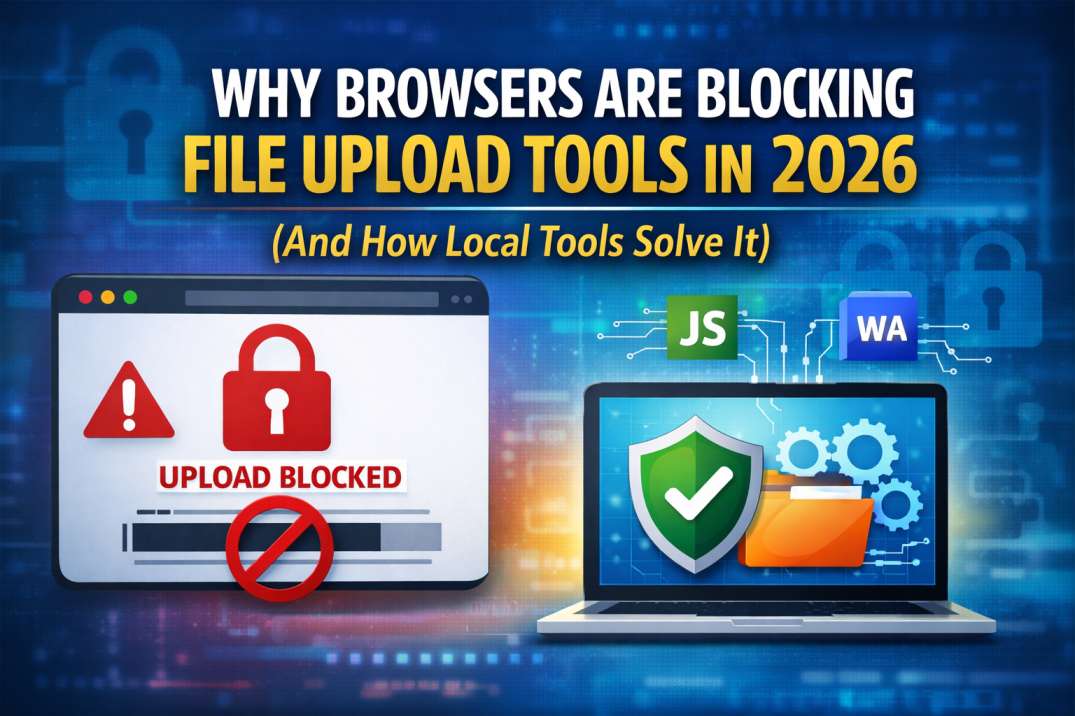
If you've tried using an online file converter, image compressor, or PDF tool recently, you may have noticed something unexpected: it doesn't work anymore. Your browser displays warnings like "Upload blocked," "File access denied," or "This site may be unsafe."
This isn't a bug. It's intentional. In 2026, major browsers—Google Chrome, Safari, and Firefox—have significantly tightened controls around file uploads to third-party websites. The tools you relied on last year may now be blocked entirely.
Here's why this is happening, why it matters, and what modern tools are doing to adapt.
About the Author
Written by the vidooplayer Team—browser security researchers with 11+ years of experience monitoring web platform changes. Our team builds privacy-first tools used by 2+ million users globally and tracks evolving browser policies to help developers adapt.
Why Browsers Are Blocking File Upload Tools
Browser vendors aren't arbitrarily breaking tools. These restrictions respond to documented security and privacy failures affecting millions of users.
Rising Privacy & Data Abuse
Users routinely upload sensitive files—IDs, tax documents, medical PDFs, personal videos—to free online tools without understanding the risks. Many of these "free converters" quietly harvest, store, or sell uploaded data. Several 2024 investigations exposed major file conversion services retaining user documents indefinitely.
Browser Security Model Changes
Modern browsers now operate on stricter sandboxing and permission models. File handling requires explicit user consent at multiple stages. The "zero-trust" approach means browsers assume any file transfer to an external server is potentially unsafe until proven otherwise.
Regulation Pressure
Data protection laws—GDPR, CCPA, and newer 2025 regulations—impose strict requirements on how user data can be processed. Many upload-based tools operate in legal gray areas. Browsers have responded by limiting what these tools can access without explicit, informed consent.
Malware & File Injection Attacks
Attackers discovered that file processing sites are ideal vectors for malware distribution. Users upload a document; they download what appears to be the processed result—but the file now contains hidden scripts or exploits. Server-side parsers have also been targeted, with malicious files exploiting vulnerabilities in processing libraries.
What Happens When You Upload a File
Understanding the upload process explains why browsers are cautious. When you use a traditional cloud-based file tool:
- File leaves your device — Data travels from your computer to an unknown server
- Sent to remote server — Your file now exists on infrastructure you don't control
- Stored temporarily or permanently — Many services retain copies, often without disclosure
- Processed outside your control — You can't verify what happens to your data
⚠️ Key Point
Once uploaded, the user loses visibility and control. There's no way to verify the file was deleted, wasn't copied, or wasn't accessed by unauthorized parties.
How Local (Client-Side) Tools Solve This
Local tools—also called client-side tools—work fundamentally differently. Instead of uploading files to a server, all processing happens directly in your browser.
The technology enabling this includes:
- JavaScript — Modern JS handles complex file operations
- WebAssembly — Near-native performance for heavy processing
- Browser APIs — Canvas, File System Access, and Web Workers enable sophisticated local operations
The result: no upload, no server storage, no privacy risk, and often faster results since there's no network latency.
Why Browsers Trust Local Tools More
Local tools align with browser security goals rather than working against them:
- No network request — Data stays on your device
- No data transfer — Nothing to intercept or store
- Reduced attack surface — No server-side vulnerabilities to exploit
- Better performance — No upload/download wait times
Browsers prefer tools that don't move user data. Local processing satisfies this requirement completely—the browser's sandbox contains everything, and no external communication occurs.
Impact on Tool Websites
The shift toward stricter browser policies is reshaping the online tools landscape:
- Upload-based tools are losing traffic — Users encounter blocks and warnings, then leave
- AdSense risk increases — Sites that handle user data aggressively face policy violations
- Client-side tools are rising — Text tools, code formatters, media previewers, and local converters are gaining adoption
Tool websites that adapt to local processing models will thrive. Those clinging to upload-dependent architectures face an increasingly hostile browser environment.
What Users Should Look for in Safe Tools
When choosing an online tool, look for these indicators:
- ❌ No forced login or account creation required
- ❌ No visible upload progress bar sending data to servers
- ✅ Clear messaging like "Works in your browser" or "No upload required"
- ✅ Open-source or transparent about processing methods
- ✅ Instant processing (local tools don't have upload latency)
Tools like our JSON Formatter and Image Resizer process everything locally—no upload required.
Why This Matters in 2026
The browser restrictions happening now aren't temporary. They reflect a permanent shift in how the web handles user data:
- Users should care — Your files contain sensitive information; protecting them matters
- Tool websites must adapt — The upload-based model is increasingly incompatible with modern browsers
- Local tools are future-proof — They work with browser security rather than against it
Privacy expectations are only increasing. Tools that respect these expectations will earn user trust—and browser approval.
Conclusion
Browsers aren't "breaking tools." They're protecting users from documented privacy and security risks that cloud-based file processors create.
The solution isn't to fight browser security—it's to embrace local processing. Client-side tools deliver the same functionality without the risks that prompted these restrictions in the first place.
Tools that adapt will win long-term. Those that don't will find their users blocked by the browsers they depend on.
How Our Tools Work
Every vidooplayer tool that handles files uses local, client-side processing. Your data never leaves your browser. You can verify this yourself—open your browser's Network tab and watch: no file data is transmitted.
Explore our local tools →Frequently Asked Questions
Why is my browser blocking file uploads to certain websites?
Modern browsers block file uploads to sites that lack proper security credentials, use insecure connections, or have been flagged for data misuse. This protects your sensitive files from being exposed to potentially harmful servers.
What's the difference between local and cloud-based file tools?
Cloud-based tools upload your file to a remote server for processing. Local (client-side) tools process files directly in your browser using JavaScript and WebAssembly—your data never leaves your device.
How can I tell if a tool processes files locally?
Check for instant processing (no upload progress bar), offline functionality, and statements like "works in your browser." You can also open browser dev tools (F12) and monitor the Network tab—local tools won't send your file data to external servers.
Are local tools as powerful as server-based tools?
Yes. Modern browser technologies like WebAssembly enable near-native performance. Most common operations—image resizing, PDF conversion, code formatting—work excellently in the browser without server processing.