In 2025, the line between real and AI-generated video has become dangerously thin. Deepfake technology has advanced to the point where even trained professionals struggle to identify synthetic content. From fake political speeches to fraudulent celebrity endorsements, the consequences of undetected deepfakes range from personal embarrassment to geopolitical crises. This guide will teach you how to verify video authenticity using accessible tools and techniques.
The 2025 Deepfake Crisis
Studies estimate that over 500,000 deepfake videos are circulating online as of January 2025—a 400% increase from 2023. The majority target individuals for fraud, blackmail, or misinformation campaigns.
Understanding Modern Deepfakes
Before learning detection, it's important to understand how deepfakes work in 2025:
How Deepfakes Are Created
- Face Swapping: AI replaces one person's face with another in video
- Lip Syncing: Manipulating mouth movements to match fabricated audio
- Full Body Synthesis: Creating entirely fictional people with realistic movements
- Voice Cloning: AI-generated audio that mimics a real person's voice
- Real-time Generation: Live video calls with deepfake overlays
Why Detection Has Become Harder
2025's deepfake tools have overcome many traditional detection markers:
- Blinking patterns are now natural
- Skin textures are highly realistic
- Lighting consistency has improved dramatically
- Audio-visual sync is nearly perfect
- Generation artifacts are minimal
The 5-Layer Verification Framework
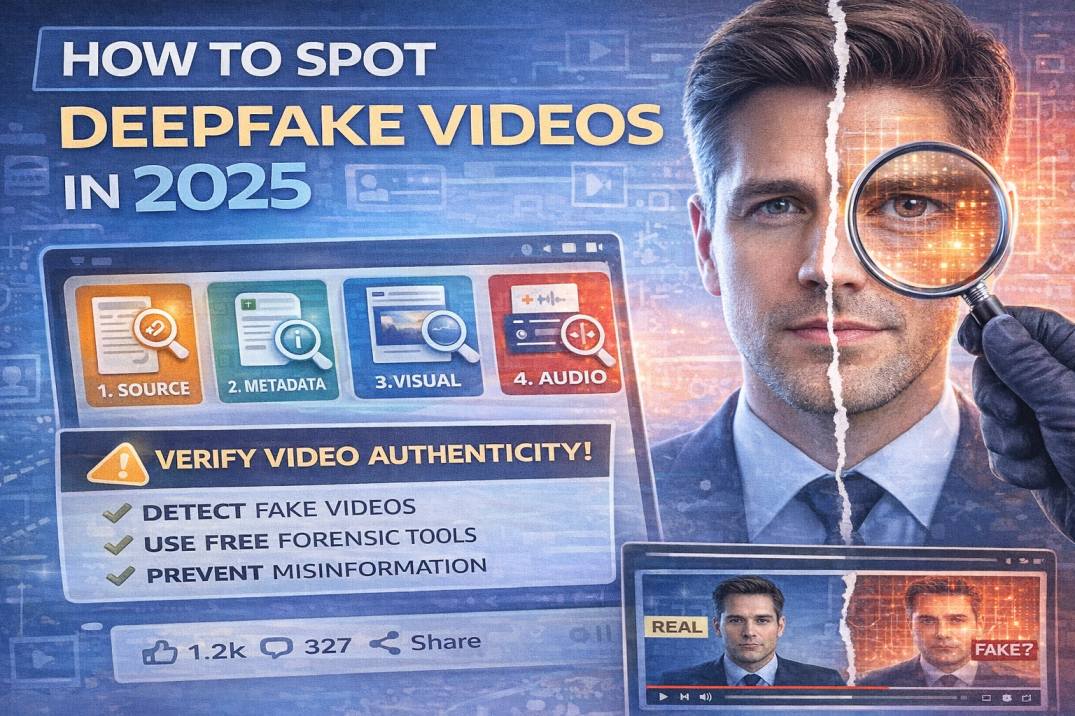
No single technique catches all deepfakes. Professional fact-checkers use a multi-layered approach:
Layer 1: Source Verification
Before analyzing the video itself, verify its origin:
- Original source: Can you trace it to the official account/channel?
- First appearance: When and where was it first posted?
- Cross-reference: Do other credible sources show the same content?
- Context check: Does the claimed event actually exist?
💡 Pro Tip: Most deepfakes are distributed without source attribution. If a dramatic video has no clear origin or appears only on secondary platforms, treat it with extreme skepticism.
Layer 2: Metadata Analysis
Video metadata often reveals manipulation. Use our Video Metadata Viewer to check:
- Creation date: Does it match the claimed event date?
- Software tags: Was it processed by known AI tools?
- Encoding details: Multiple compressions suggest editing
- Camera information: Real footage usually includes device data
- GPS data: Location metadata (if present) should match claims
Red flags in metadata:
- Missing or stripped metadata
- Mismatched creation dates
- Generic encoder strings (like "Python" or "FFmpeg" without camera info)
- Resolution inconsistencies
Layer 3: Visual Inspection
Manual frame-by-frame analysis catches artifacts AI can't fully hide. Use our Video Frame Screenshot tool to capture and examine individual frames:
What to Look For
- Edge bleeding: Blurry boundaries around face, hair, or ears
- Asymmetry: Slight differences between left and right facial features
- Skin texture: Over-smoothed or plastic-looking skin
- Eye reflections: Inconsistent or missing light reflections in eyes
- Teeth quality: Blurry, misshapen, or oddly colored teeth
- Jewelry/accessories: Earrings, glasses, or collars that warp unnaturally
- Background inconsistencies: Warping or distortion near head movements
Motion Analysis
Use our Video Loop Section Preview to replay suspicious segments at reduced speed:
- Lip sync accuracy: Does mouth movement match audio perfectly?
- Micro-expressions: Are facial expressions natural and varied?
- Head movement: Does the face "slide" on the head during turns?
- Lighting consistency: Does lighting on the face match the environment?
Video Forensic Tools
Free tools for video authenticity verification
Layer 4: Audio Analysis
Voice cloning technology has advanced, but still leaves traces:
- Background noise consistency: AI-generated audio often has uniform background
- Breathing patterns: Real speech includes natural breathing sounds
- Emotional variation: Cloned voices may sound flat or monotone
- Acoustic environment: Room echo should match the visual setting
- Speech patterns: Compare against known authentic recordings
Layer 5: Contextual Analysis
Sometimes logic reveals fakes better than technology:
- Clothing/setting match: Does the outfit match the claimed date?
- Weather verification: Was it actually sunny that day in that location?
- Event timeline: Was the person actually there at that time?
- Statement plausibility: Would this person really say this?
- Distribution motive: Who benefits from this video existing?
Image Verification Techniques
Deepfake images (often called "AI portraits") are even more common than videos. For image verification:
EXIF Data Analysis
Use our EXIF Viewer to examine image metadata:
- Camera make/model: AI images lack real camera data
- Lens information: Real photos include lens specs
- GPS coordinates: Location data (if not stripped)
- Creation timestamp: Original capture time
- Software history: Editing applications used
Visual Markers in AI Images
- Hands and fingers: AI struggles with finger count and positioning
- Text in images: Letters often appear distorted or nonsensical
- Symmetry errors: Earrings, eyes, or shoulders don't match
- Background logic: Objects that don't make physical sense
- Hair detail: Strands may merge or disappear unnaturally
Real-World Detection Case Study
Let's walk through detecting a hypothetical deepfake video:
Scenario
A video circulates showing a CEO announcing their company's bankruptcy. Stock prices drop 15% before markets close.
Verification Process
- Source check: Video first appeared on an anonymous Twitter account, not official company channels. 🚩 Red flag
- Metadata analysis: Video metadata shows no camera information, creation date is today. 🚩 Red flag
- Frame inspection: At 0.25x speed, subtle facial sliding visible during head turns. 🚩 Red flag
- Audio analysis: Room acoustics don't match the visible office environment. 🚩 Red flag
- Context check: CEO was photographed at a conference in another city at the claimed time. 🚩 Definitive proof of fake
Result: Deepfake confirmed within 45 minutes. Company issues denial, stock recovers.
Tools You Can Use Today
Professional forensic labs use specialized software, but these accessible tools help with initial verification:
Free Browser-Based Tools
- Video Metadata Viewer: Inspect video file metadata
- Video Frame Screenshot: Capture individual frames for analysis
- Video Loop Preview: Review suspicious sections at slow speed
- EXIF Viewer: Analyze image metadata
- Speed Controller: Watch at 0.25x-0.5x to catch artifacts
Limitations
Important to understand what these tools can't do:
- Cannot definitively prove a video is real (only identify fakes)
- Cannot detect AI content that's been heavily compressed
- Cannot analyze content without downloading the file
- Cannot provide certainty without multiple verification layers
⚠️ Important Note: If you believe you've encountered a deepfake that's being used for fraud, harassment, or election interference, report it to the relevant platform and consider contacting law enforcement. Document your verification process as evidence.
Protecting Yourself from Deepfakes
Beyond detection, here's how to reduce your risk:
Personal Protection
- Limit public videos: Training data comes from your public content
- Watermark professional content: Harder to cleanly remove
- Create verification phrases: Agree on code words with family for video calls
- Monitor your likeness: Search for your name + "video" regularly
Business Protection
- Establish verification protocols: Never execute major transactions based on video alone
- Multi-channel confirmation: Verify important communications through separate channels
- Employee training: Teach staff to recognize social engineering using deepfakes
- Incident response plan: Know what to do if a deepfake of your executives appears
The Future of Detection
As AI generation improves, so must detection:
- Blockchain provenance: Content signed at capture for chain of custody
- AI detection models: Neural networks trained to spot AI artifacts
- Hardware-level authentication: Cameras that cryptographically sign footage
- Platform-level labeling: Social networks flagging AI content automatically
However, this will always be an arms race. Human verification skills remain crucial.
Conclusion: Trust but Verify
In 2025, the default assumption for any dramatic video should be skepticism. Before sharing, reacting, or making decisions based on video content:
- Verify the source
- Check the metadata
- Inspect frames closely
- Analyze audio separately
- Apply contextual logic
The few minutes spent verifying could prevent you from spreading misinformation, falling for fraud, or making decisions based on fabricated evidence.
🔍 Start Verifying Videos Today
Use our free forensic tools to analyze video and image authenticity:
- Video Metadata Viewer — Check video source and encoding info
- Frame Screenshot — Capture and analyze individual frames
- Video Loop Preview — Review suspicious moments at slow speed
- EXIF Viewer — Analyze image metadata and camera info