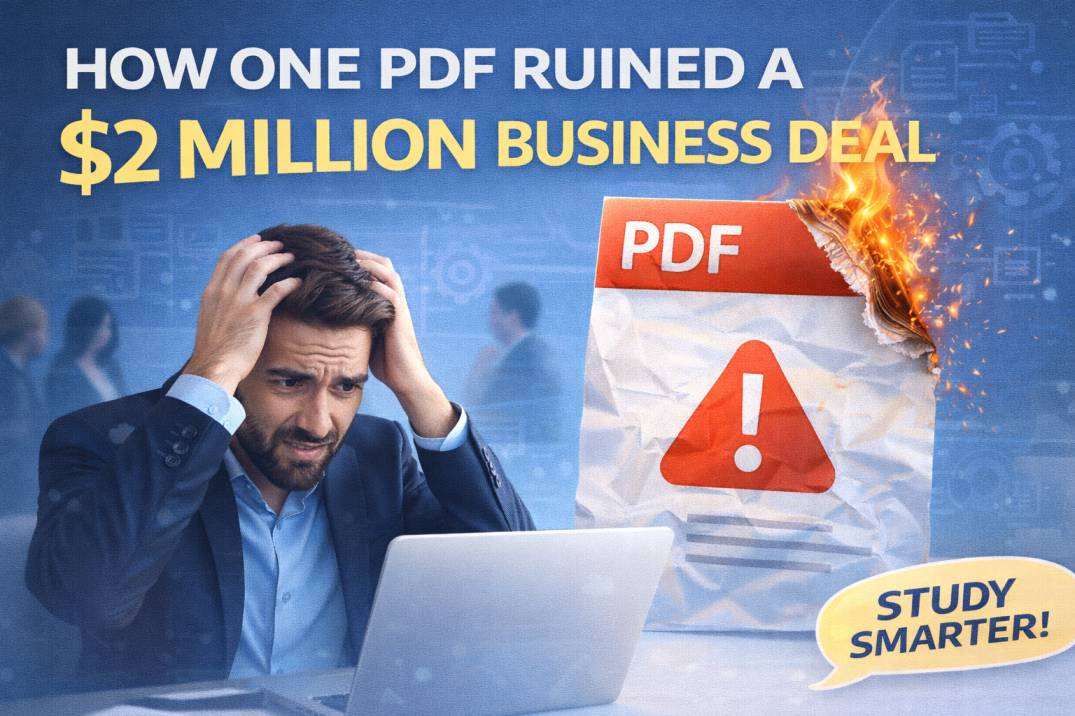
In March 2024, a $2.3 million acquisition between two mid-sized tech companies collapsed in the final 72 hours. The cause wasn't a disagreement on valuation, a failed due diligence check, or cold feet from the investors. It was a single corrupted PDF file. This is that story—and more importantly, the lessons every business can learn from it.
True Story Notice
While company names and specific financial details have been anonymized for confidentiality, the core events of this story are based on real incidents shared by legal professionals and business consultants in the M&A industry.
Chapter 1: The Deal of a Lifetime
"Apex Digital Solutions" (not its real name) was a 12-year-old software consultancy based in Austin, Texas. After years of steady growth, its founders were ready to exit. They'd found their buyer: "TechVenture Holdings," a private equity-backed firm aggressively rolling up boutique consulting shops.
The deal had been in negotiation for nine months. Lawyers on both sides had logged hundreds of billable hours. The purchase price was finalized at $2.3 million in cash, plus an earnout worth another $400,000. For the founders of Apex, it was the culmination of over a decade of work. They were 72 hours from closing.
The final step was simple: both parties would sign the Stock Purchase Agreement (SPA), a 47-page PDF document that had been meticulously drafted by a top-tier law firm. TechVenture's legal counsel would receive the signed PDF, verify the signatures, and release the funds from escrow.
What could possibly go wrong?
Chapter 2: The Phantom Signature
On a Tuesday evening, Apex's CEO, "Mark," used a standard e-signature platform to sign the SPA. The platform embedded his digital signature into the PDF and sent a copy to both his lawyer and TechVenture's counsel. Mark closed his laptop and opened a bottle of champagne with his co-founder. They felt like they'd already won.
The next morning, Mark's phone rang at 7:15 AM. It was his lawyer, and her voice was tense.
"Mark, we have a problem. TechVenture says they received the PDF, but your signature isn't there. The page is blank."
Mark didn't understand. He'd watched the signature appear on the document. He had a confirmation email. But when TechVenture's counsel opened the file on their end, Page 46—the signature page—was completely empty. No signature, no date, no initials. Just white space.
The Technical Explanation
What happened was a perfect storm of PDF incompatibility. Here's what we now know:
- The SPA was originally drafted in Microsoft Word by Apex's law firm.
- It was converted to PDF using an older version of Adobe Acrobat.
- The e-signature platform added the signature as a form field layer—a transparent overlay on top of the original PDF.
- TechVenture's legal team opened the document using a different PDF reader (Foxit Reader) that did not render the form field layer correctly.
- The result: the signature was technically there, but invisible to the receiving party.
This is a known issue in document processing. Different PDF readers handle "layers" and "form fields" differently. What appears perfectly on one screen may be invisible on another.
💡 Industry Insight: The PDF Compatibility Problem
According to PDF Association research, over 15% of electronically signed documents experience some form of rendering inconsistency between creation and viewing environments. Most are minor (font shifts, spacing issues), but a small percentage—like this case—can result in critical data or signatures becoming invisible.
Chapter 3: The Fallout
What should have been a 5-minute fix—re-sending the PDF—turned into a 48-hour nightmare. Here's the cascade of events:
- Hour 1-4: Mark tries to re-sign the document. The e-signature platform's audit trail shows he's already signed. It won't let him sign again without invalidating the first signature.
- Hour 5-8: Lawyers attempt to manually merge a screenshot of the signature into the PDF. TechVenture's legal team rejects this as it breaks the chain of custody and is not legally compliant.
- Hour 9-16: Both legal teams engage in calls to verify the document. TechVenture's CTO, a notoriously paranoid executive, becomes concerned. "If they can't even send a PDF correctly, what else is wrong with their operations?"
- Hour 17-24: TechVenture requests a one-week delay to "re-evaluate security protocols." Apex's founders panic. A delay means missing the funding window for TechVenture's next investment round.
The Hidden Costs of Delay
A one-week delay doesn't sound catastrophic, but in the world of M&A, timing is everything. During that week:
- TechVenture's board questioned the acquisition. If document management was this sloppy, what about their codebase? Their contracts?
- Apex's key software engineer, who had been offered a retention bonus tied to the acquisition, accepted a competing offer from Google. He couldn't wait any longer.
- A competitor of Apex caught wind of the delay and began poaching Apex's largest client.
By the time TechVenture's board reconvened, the deal had lost momentum. The acquirer requested a $350,000 reduction in purchase price to account for the "operational risk" exposed by the incident. Apex's founders, exhausted and desperate, agreed.
A corrupted PDF—a technical glitch that would take 60 seconds to diagnose with proper tools—had just cost them $350,000.
Chapter 4: The Lessons
If you're reading this and thinking, "That could never happen to me," think again. PDF-related issues derail more business transactions than most people realize. Here are the critical lessons from Apex's story:
Lesson 1: Always Test Your Documents on Multiple Readers
Before sending any critical PDF, open it in at least two different PDF readers (Adobe Acrobat, Foxit, browser-based viewers). Verify that all content—especially signatures, form fields, and images—renders correctly. This takes 60 seconds and could save you millions.
Lesson 2: Flatten Your PDFs Before Sharing
"Flattening" a PDF means permanently merging all layers (annotations, form fields, signatures) into the base document. A flattened PDF looks identical on every reader because there are no separate layers to interpret.
Use our PDF Merge Tool to combine and flatten documents into a single, universally compatible file.
Lesson 3: Never Assume "Sent" Means "Received Correctly"
After sending any important document, ask the recipient to confirm they can view it correctly. This is especially critical for legal documents, contracts, and anything with digital signatures.
Lesson 4: Reduce File Size (It's Not Just About Speed)
Large PDF files are more likely to encounter transmission errors, get blocked by email filters, or fail to upload to legal management platforms. Compressing your PDFs isn't just about convenience—it's about reliability.
Use our PDF Compressor to reduce file size without sacrificing quality.
Lesson 5: Strip Metadata (The Hidden Privacy Risk)
PDFs often contain hidden metadata: author names, revision history, GPS coordinates (if created from scanned documents), and more. In sensitive business transactions, this metadata can leak confidential information.
Before sharing legal documents, always clean the metadata. For images embedded in PDFs, use our EXIF Remover to strip location and device data.
Chapter 5: The Aftermath
Apex Digital Solutions eventually closed the deal—but at a significantly lower valuation. The two founders split $1.95 million instead of $2.3 million. After paying taxes, legal fees, and distributiing to minor shareholders, each founder walked away with approximately $180,000 less than expected.
Mark now consults for startups preparing for acquisition. His number one rule? "Test your damn PDFs."
"We spent $80,000 on lawyers to draft a perfect deal. We spent zero dollars testing whether the document would actually work. That's the most expensive lesson I've ever learned."
The Bigger Picture: Digital Hygiene in Business
The Apex story isn't just about PDFs. It's about a broader truth: small technical oversights carry massive business risks. In an era where most business happens digitally, "document hygiene" is as important as legal due diligence.
Consider the following scenarios, all of which have derailed real business deals:
- A pitch deck with embedded fonts that failed to render on the investor's computer.
- An NDA with a corrupted signature field that rendered the agreement unenforceable.
- A merger proposal where different versions of a PDF were being discussed by each side—without either party realizing it.
- A product demo screenshot that accidentally included the developer's browser tabs (revealing a competitor's pricing page).
Each of these could have been prevented with basic document checks and the right tools.
Your Document Hygiene Checklist
Before sending any business-critical document, run through this checklist:
- View it on multiple devices/readers. What you see isn't always what they get.
- Flatten layers. Remove form fields and merge annotations.
- Compress the file. Smaller files = fewer transmission errors.
- Strip metadata. Remove hidden author info, revision history, and location data.
- Request confirmation. Ask the recipient to confirm they can view/sign correctly.
- Keep version control. Use numbered filenames (Contract_v3_Final.pdf) and archive every version.
🛠️ Tools to Keep Your Documents Safe
Use vidooplayer's free document tools to prevent PDF disasters:
- PDF Merge & Flatten — Combine documents into a single, compatible file.
- PDF Compressor — Reduce file size for reliable sharing.
- EXIF Metadata Remover — Strip hidden data from images and scans.
- File Hash Generator — Verify document integrity after transmission.
Conclusion: The $350,000 PDF
Mark's story is extreme, but the underlying lesson is universal. In the digital age, document reliability is a business asset. A PDF isn't just a file—it's a representation of your professionalism, your attention to detail, and your operational competence.
The next time you're about to send a critical document—a contract, a proposal, a signed agreement—pause. Take 60 seconds to verify it works. Because the cost of that minute? Potentially zero dollars. The cost of skipping it? Ask Mark. He'll tell you it's $350,000.
Don't let a PDF ruin your business deal. Test your documents. Use the right tools. And never assume "sent" means "received."