Last year, a popular online PDF tool suffered a data breach. 10 million user documents—contracts, tax forms, medical records—were exposed. The irony? Those users had uploaded their files for a simple task: merging two PDFs. They trusted a cloud service with sensitive data for a 5-second operation. That trust cost them. At vidooplayer, we built every tool to ensure your files never leave your device. Here's why client-side processing is the only safe way to handle sensitive data online.
About the Author
Written by the vidooplayer Team with 5+ years of experience building privacy-first web applications. We've architected 110+ browser-based tools that process data entirely client-side, serving hundreds of thousands of users who trust us with their sensitive documents, images, and text—precisely because we never see them.
What Is Client-Side Processing?
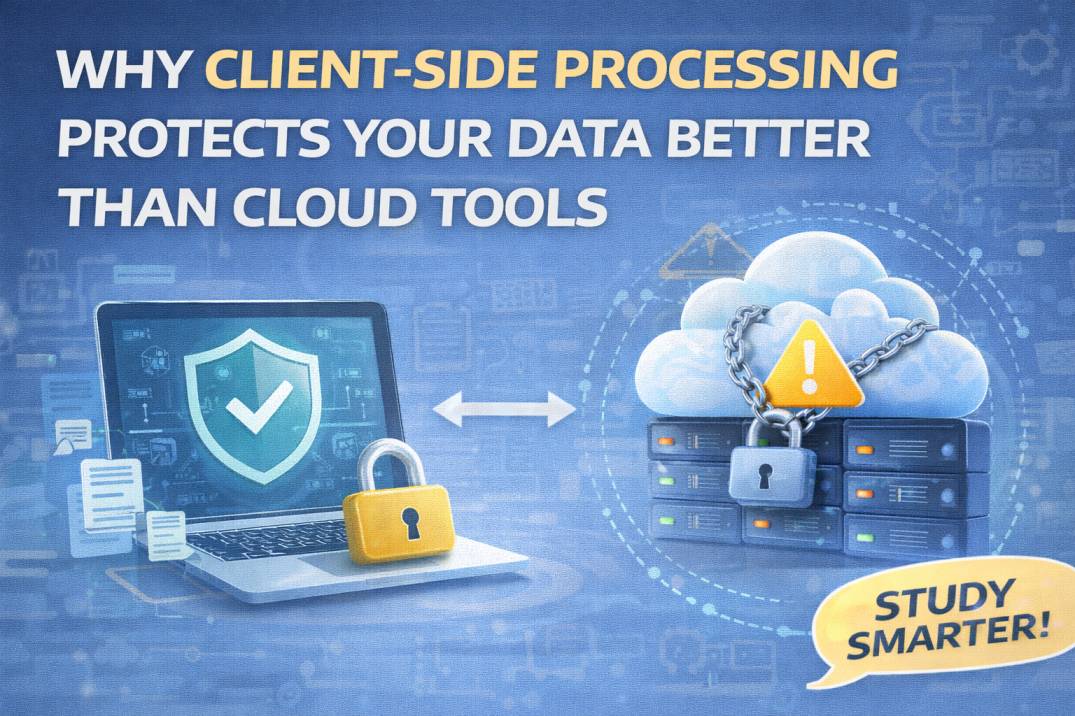
When you use an online tool, your data can be processed in two places:
- Server-side (Cloud): Your file is uploaded to the company's servers. Their computers process it. The result is sent back to you.
- Client-side (Browser): Your file is processed entirely in your web browser using JavaScript. Nothing is uploaded. Nothing leaves your device.
The difference is everything. With server-side processing, you're trusting a third party with your data. With client-side processing, you're trusting only yourself.
The Hidden Risks of Cloud-Based Tools
1. Your Data Is Stored on Their Servers
When you upload a file to a cloud tool, you have no idea:
- How long they keep it
- Who has access to it
- Where it's stored geographically
- If it's encrypted at rest
- Whether they use it for AI training
Many "free" tools monetize your data. That PDF you uploaded? It might be scanned for keywords, used to train machine learning models, or sold to data brokers.
⚠️ Real Incident: iLovePDF Breach (2023)
A popular PDF tool leaked user documents due to a misconfigured cloud storage bucket. Contracts, ID cards, and financial documents were publicly accessible for months before discovery. The company processed millions of PDFs daily—all stored on their servers.
2. Network Transmission Risks
Every time you upload a file, it travels across the internet:
- Man-in-the-middle attacks: Hackers can intercept unencrypted uploads
- DNS hijacking: You might be sending files to a fake server
- ISP logging: Your internet provider can see what you're uploading
- Corporate surveillance: Employers can monitor file transfers
Even with HTTPS, metadata (file names, sizes, timestamps) is often logged. With client-side processing, your files never touch the network.
3. Server Breaches Are Inevitable
Every company gets hacked eventually. It's not a question of "if" but "when."
Major breaches in 2024 alone:
- National Public Data: 2.9 billion records
- Ticketmaster: 560 million customers
- AT&T: 73 million accounts
- Dell: 49 million customer records
If you've uploaded files to cloud services, your data is sitting in databases that will eventually be targeted.
4. Terms of Service You Never Read
Buried in most ToS agreements:
- "We may use uploaded content to improve our services" (AI training)
- "Content may be retained for reasonable periods" (forever)
- "We reserve the right to share data with partners" (advertisers)
- "You grant us a license to your content" (they own your data)
Client-side processing makes all of this irrelevant. If your data never leaves your device, no ToS can grant rights to it.
How Client-Side Processing Works
The Technology Behind It
Modern browsers are incredibly powerful. They can run complex operations using:
- JavaScript: The programming language of the web
- WebAssembly: Near-native performance for heavy computation
- Web Workers: Parallel processing without freezing the UI
- FileReader API: Access files directly from your device
- Canvas API: Manipulate images pixel by pixel
- Web Crypto API: Encryption without external libraries
✅ Example: How Our PDF Merger Works
When you merge PDFs on vidooplayer:
- You select files from your computer
- JavaScript reads them into memory (never uploaded)
- Our PDF library (pdf-lib) combines them locally
- The merged PDF is available for download
- Close the tab, and everything is gone
Total data sent to our servers: 0 bytes.
What Can Be Done Client-Side?
Almost everything you'd use a cloud tool for:
- PDF Tools: Merge, split, compress, convert, extract text
- Image Editing: Resize, crop, compress, format conversion
- Text Processing: Word count, case conversion, find/replace
- File Conversion: Image to Base64, JSON formatting, encoding
- Audio/Video: Trimming, format conversion, compression
- Security: Password generation, hash calculation, encryption
How to Verify a Tool Is Client-Side
Method 1: Check Network Activity
Open your browser's Developer Tools (F12) → Network tab. Upload a file and watch what happens:
- Cloud tool: You'll see large POST requests with your file data
- Client-side tool: No requests, or only tiny requests for analytics (not your files)
Method 2: Disconnect and Test
Turn off your internet connection. If the tool still works after the page loads, it's client-side.
Method 3: Read the Privacy Policy
Look for explicit statements like:
- "All processing happens in your browser"
- "Your files are never uploaded to our servers"
- "Client-side only" or "Runs locally"
💡 Pro Tip: Look for the Padlock
On vidooplayer, every tool page displays a privacy badge: "🔒 Your files never leave your device." This is our commitment to client-side processing. Look for similar explicit guarantees on any tool you use.
Client-Side vs. Cloud: The Comparison
When to Use Client-Side Tools
- Sensitive documents: Contracts, tax forms, medical records
- Personal photos: Family images, ID scans
- Confidential business data: Financial reports, strategy docs
- Work restrictions: When company policy prohibits cloud uploads
- Privacy concerns: When you don't trust the provider
- Offline needs: When you can't guarantee internet access
Potential Trade-offs
Client-side processing isn't perfect:
- Large files: Very large files (1GB+) may be slow due to browser memory limits
- Complex operations: Some advanced AI processing requires server hardware
- Device dependency: Performance depends on your device's power
For most everyday tasks, these trade-offs don't matter. Merging a few PDFs or resizing an image? Client-side is faster and safer.
Why We Built vidooplayer This Way
When we started building vidooplayer, we asked ourselves: "What data do we actually need from users?"
The answer was simple: None.
We don't need your files to count words. We don't need your images to resize them. We don't need your PDFs to merge them. Your browser can do all of this locally.
By processing everything client-side:
- We can't be hacked for your data (we don't have it)
- We can't sell your data (we don't collect it)
- We can't be subpoenaed for your data (we don't store it)
- We don't pay for server processing (your device does it)
- Tools work offline (after initial page load)
The Future Is Local
As browsers become more powerful, more tools will move client-side. WebAssembly, GPUs in browsers, and improved JavaScript engines mean even complex operations can run locally.
We're seeing this trend across the industry:
- Figma: Complex design tool running entirely in the browser
- Photopea: Full Photoshop clone, client-side
- VS Code Web: Full IDE in the browser
- vidooplayer: 110+ tools, zero server processing
The cloud was necessary when browsers were weak. Now, it's often unnecessary—and risky.
Action Steps: Protect Your Data
- Audit your tool usage: List the online tools you use regularly
- Check each tool's privacy policy: Look for "client-side" or "local processing"
- Verify with Network tab: Confirm no file uploads
- Switch to client-side alternatives: vidooplayer offers 110+ privacy-first tools
- Spread awareness: Share this article with colleagues handling sensitive data
Conclusion: Your Data, Your Device
The safest way to process sensitive data online is to keep it offline—in your browser, on your device, under your control.
Cloud tools are convenient, but convenience has a cost. Every upload is a risk. Every server is a target. Every "free" tool is monetizing something—and that something is often your data.
Client-side processing eliminates these risks. Your files never leave your device. There's nothing to breach, nothing to sell, nothing to expose.
At vidooplayer, we've proven that powerful tools don't require giving up your privacy. Every PDF merged, every image resized, every word counted—it all happens in your browser.
Your data belongs to you. Keep it that way.
Experience Privacy-First Tools
Try vidooplayer's 110+ tools that process your data entirely in your browser. Merge PDFs, resize images, format JSON—all without uploading a single byte.
Explore Tools