
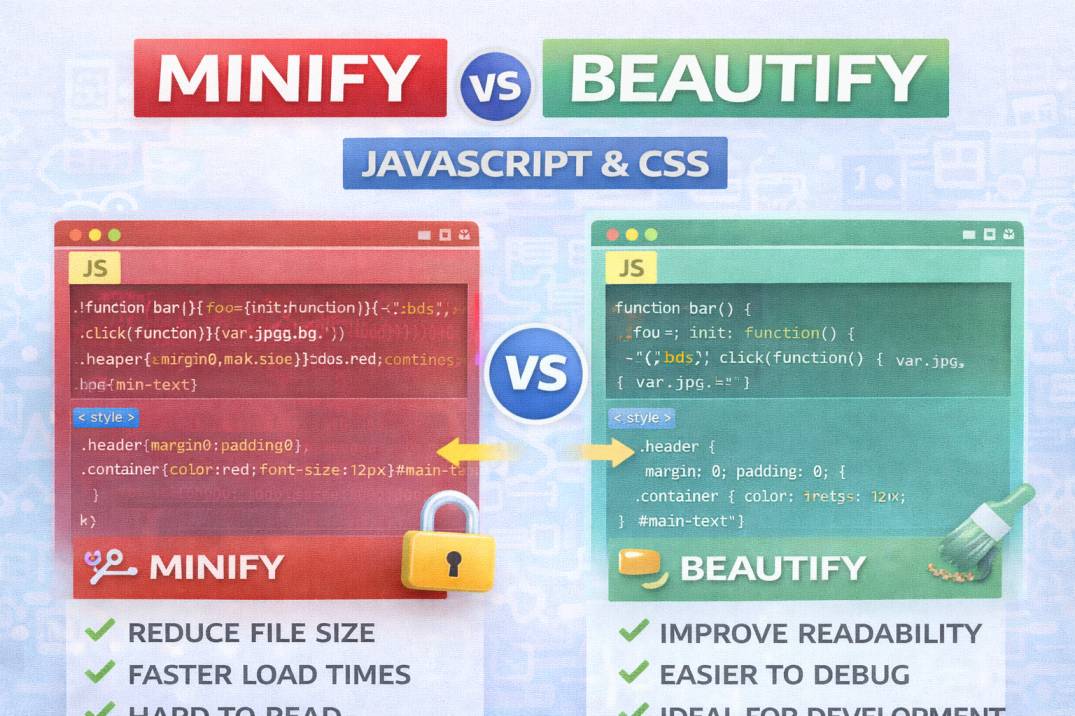
I once spent 3 hours debugging a JavaScript error that didn't exist. The problem? I was looking at minified code trying to trace a bug at line 1, column 47,892. After beautifying the file, the actual issue—a missing semicolon—took 30 seconds to find. That experience taught me something every developer learns eventually: knowing when to minify and when to beautify is as important as knowing how to code. Here's everything you need to know about both.
About the Author
Written by the vidooplayer Team with 8+ years of experience in front-end development and performance optimization. We've built and maintained 100+ production websites, reduced load times by 40-60% through minification strategies, and created developer tools used by thousands of programmers daily.
What Is Minification?
Minification is the process of removing all unnecessary characters from code without changing its functionality. This includes:
- Whitespace: Spaces, tabs, and newlines
- Comments: Both single-line and multi-line
- Unnecessary semicolons: Where JavaScript allows omission
- Long variable names: Shortened to single characters (in advanced minifiers)
Example: Before and After Minification
Original JavaScript (342 bytes): A typical function with comments, descriptive variable names, and proper indentation takes up significant space.
Minified JavaScript (78 bytes - 77% smaller!): The same function compressed to a single line with shortened variable names and no whitespace.
Try it yourself with our JS Minifier tool to see the difference!
What Is Beautification?
Beautification (also called "prettifying" or "formatting") is the opposite of minification. It transforms compressed, unreadable code into properly formatted, human-readable code with:
- Proper indentation: Consistent spacing (tabs or spaces)
- Line breaks: Each statement on its own line
- Consistent formatting: Standardized bracket placement, spacing around operators
- Readable structure: Clear visual hierarchy
✅ When Beautification Saved the Day
A client sent us "broken" JavaScript from their production site. It was a 500KB single-line file. After beautifying, we found the issue in 2 minutes: a misplaced closing bracket on what became line 2,847. Without beautification, this would have been nearly impossible to debug.
When to Use Minification
1. Production Deployment
Always minify code before deploying to production. This is non-negotiable for modern web development.
Benefits:
- Faster downloads: 30-80% smaller file sizes
- Reduced bandwidth costs: Less data transferred
- Improved Core Web Vitals: Better LCP and FCP scores
- Basic obfuscation: Harder (not impossible) to read
2. Third-Party Libraries
When including libraries you don't need to modify:
- jQuery: Use jquery.min.js, not jquery.js
- React: Use react.production.min.js
- Bootstrap: Use bootstrap.min.css
3. CDN Distribution
Files served from CDNs should always be minified. Combined with gzip compression, you can achieve 90%+ size reduction.
💡 Real Impact: Size Comparison
| Library | Original | Minified | Savings |
|---|---|---|---|
| jQuery 3.7 | 287 KB | 87 KB | 70% |
| React 18 | 143 KB | 6.4 KB | 96% |
| Bootstrap 5 CSS | 227 KB | 163 KB | 28% |
When to Use Beautification
1. Debugging Minified Code
When you encounter an error in production code:
- Copy the minified file
- Run it through a beautifier
- Find the error location
- Trace back to your source code
2. Reviewing Third-Party Code
Before including external scripts, beautify them to:
- Audit for security issues
- Understand what they're doing
- Check for malicious code
- Verify no tracking scripts are hidden
⚠️ Security Warning
Malicious actors often hide harmful code in minified scripts, counting on developers not to read them. In 2023, a popular npm package was found to contain cryptocurrency mining code hidden in minified code. Beautifying the script revealed the malicious payload.
3. Learning from Others' Code
Want to understand how a website implements a feature? Beautify their JavaScript to learn their techniques.
4. Fixing Formatting Inconsistencies
When team members use different editors or settings, beautification enforces consistent style:
- Tabs vs. spaces debates: solved
- Bracket placement: standardized
- Semicolon usage: consistent
5. Code Reviews
Beautified code is easier to review. Consistent formatting lets reviewers focus on logic, not style.
The Development Workflow
The Golden Rule
Write beautified. Ship minified.
- Development: Work with formatted, commented code
- Version Control: Commit readable source files
- Build Process: Minify automatically during build
- Production: Deploy only minified versions
Modern Build Tools
Most build tools handle this automatically:
Webpack Configuration
module.exports = {
    mode: 'production', // Automatically minifies
    optimization: {
        minimize: true,
        minimizer: [
            new TerserPlugin(), // JS minification
            new CssMinimizerPlugin() // CSS minification
        ]
    }
};
Vite Commands
npm run build  # Automatically minifies for production
npm run dev    # Keeps code readable for development
CSS-Specific Considerations
CSS Minification
CSS minification removes:
- Whitespace and newlines
- Comments
- Unnecessary semicolons
- Redundant units (0px → 0)
- Color optimizations (#ffffff → #fff)
Before Minification
.card {
    background-color: #ffffff;
    padding: 20px;
    margin: 0px;
    border-radius: 8px;
    box-shadow: 0 2px 4px rgba(0, 0, 0, 0.1);
}
✅ After Minification
.card{background-color:#fff;padding:20px;margin:0;border-radius:8px;box-shadow:0 2px 4px rgba(0,0,0,.1)}CSS Beautification
Beautifying CSS helps when:
- Debugging specificity issues
- Understanding complex selectors
- Reviewing vendor-prefixed code
- Learning CSS architecture patterns
JavaScript-Specific Considerations
Advanced Minification (Uglification)
JavaScript minifiers like Terser go beyond whitespace removal:
- Variable renaming: userProfile → a
- Dead code elimination: Removes unused functions
- Constant folding: Computes expressions at build time
- Inline expansion: Replaces function calls with function bodies
Before Uglification
const MILLISECONDS_PER_DAY = 24 * 60 * 60 * 1000;

function getDaysDifference(date1, date2) {
    const difference = Math.abs(date2 - date1);
    return Math.floor(difference / MILLISECONDS_PER_DAY);
}
✅ After Uglification (constants computed)
function getDaysDifference(e,n){return Math.floor(Math.abs(n-e)/864e5)}Source Maps: The Best of Both Worlds
Source maps connect minified code to original source, enabling:
- Debug minified code as if it were original
- See original filenames and line numbers in errors
- Set breakpoints in original code
✅ Pro Tip: Generate Source Maps
Always generate source maps for production. Keep them private (don't expose to public) but available for debugging. This gives you production performance with development-level debugging.
Common Mistakes to Avoid
1. Minifying Already Minified Code
Running minification twice provides no benefit and can sometimes break code.
2. Serving Unminified Code in Production
This wastes bandwidth and hurts performance. Always minify production code.
3. Debugging Without Beautifying First
Don't waste time reading minified code. Beautify it first, then debug.
4. Version Control Conflicts
Never commit both minified and unminified versions. Let your build process generate minified files.
5. Inconsistent Formatting in Teams
Use shared config files (.prettierrc, .eslintrc) to ensure everyone's code looks the same.
Tools for Minification and Beautification
Online Tools (Quick Use)
- vidooplayer JS Minifier: Client-side, privacy-first
- vidooplayer CSS Minifier: Instant optimization
- vidooplayer JS Beautifier: Format any JavaScript
- vidooplayer CSS Beautifier: Prettify stylesheets
Build Tools (Automated)
- Terser: Modern JavaScript minifier
- CSSNano: CSS optimization
- Webpack: Bundling with built-in minification
- Vite: Fast builds with automatic optimization
- esbuild: Extremely fast bundler/minifier
IDE Extensions (Development)
- Prettier: Opinionated code formatter
- ESLint: Linting with auto-fix
- Format on Save: Built into VS Code
Performance Impact: Real Numbers
We tested minification impact on a typical web application:
| Metric | Unminified | Minified | Improvement |
|---|---|---|---|
| JS Bundle Size | 847 KB | 312 KB | 63% smaller |
| CSS Bundle Size | 124 KB | 89 KB | 28% smaller |
| Load Time (3G) | 4.2s | 2.1s | 50% faster |
| Lighthouse Score | 67 | 89 | +22 points |
Conclusion: Use Both, Use Wisely
Minification and beautification aren't competing techniques—they're complementary tools for different situations:
- Minify for production, performance, and deployment
- Beautify for debugging, learning, and code review
- Use source maps to bridge the gap
- Automate with build tools for consistent results
At vidooplayer, we offer both minification and beautification tools that run entirely in your browser. Your code stays private while you optimize for production or format for readability. No uploads, no servers, no privacy concerns.
Remember: Write readable code. Ship optimized code. Debug with the right tools.
Try Our Code Tools
Minify or beautify your JavaScript and CSS instantly with vidooplayer's browser-based tools. Zero uploads, complete privacy, professional results.